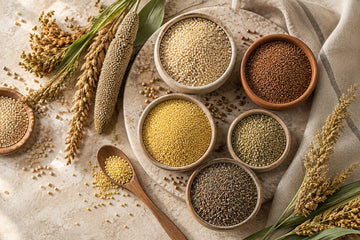
Sustainable Agriculture means an agricultural system in which the needs of today are met while soil, water, biodiversity, and natural resources are preserved for future generations. Millets hold special significance in India's agricultural system. Millets like bajra, jowar, ragi, kodo, kutki, sanwa, and kangni have traditionally been a part of Indian farmers' crops. Dhanshakti – The Wonder Millets believes that healthy food starts not just from the kitchen, but from the field and the soil. Therefore, understanding sustainable agriculture and responsible sourcing is also important for us.
Why is Sustainable Agriculture necessary?
Agriculture is the foundation of our food system. But the continuously growing population, demand for water, changes in soil quality, and climate-related challenges are creating new challenges for agriculture. The aim of sustainable agriculture is not just to produce more. Its goal is:
Maintaining soil fertility
Using water judiciously
Protecting natural resources
Promoting biodiversity
Strengthening farmers' income and livelihoods
Ensuring long-term sustainable food production
Let us know 8 important ways of sustainable agriculture.
1. Focus on soil health
Healthy soil is the first requirement for good agriculture. Organic matter, microorganisms, and essential nutrients in the soil play a vital role in crop growth. For this, farmers can:
Properly manage crop residues
Use organic matter
Adopt crop rotation
Get soil tested regularly
If the soil is healthy, agriculture will remain sustainable for a long time.
2. Adopt crop rotation
Growing the same crop continuously in the same field can lead to a deficiency of certain nutrients in the soil and increase pest or disease problems. Crop rotation, i.e., growing different crops in different seasons, can help maintain soil health. Including millets in various cropping systems can also be an option for farmers.
3. Use water efficiently
In many regions of India, water is a crucial resource for agriculture. In sustainable agriculture, it is necessary to use water according to requirements. For this:
Using drip or other efficient irrigation methods
Rainwater harvesting
Soil moisture conservation
Irrigation at the right time
Preventing unnecessary wastage of water
Such measures can be adopted.
4. Promote diverse crops like millets
Millets are an important part of India's traditional crops. Crops like jowar, bajra, ragi, kodo, kutki, and kangni can contribute to diversifying Indian agriculture. Promoting millets can also provide farmers with the opportunity to reach new markets for traditional crops. This is why Dhanshakti's aim is not just to make millet products, but also to connect Indian millets to the modern market.
5. Protect biodiversity
Instead of relying on only one or two crops in agriculture, promoting different crops and local varieties can make the agricultural system more diverse. Trees and plants around farms, pollinating insects, and other useful organisms are also part of the agricultural ecosystem. Protecting biodiversity is important for the future of agriculture.
6. Use chemical inputs responsibly
Fertilizers and pesticides can play an important role in agriculture, but their use should always be according to need and in appropriate quantities. Through methods like Integrated Pest Management (IPM), farmers can manage pests and diseases in a more systematic way. Wherever appropriate, organic and natural agricultural measures can also be included in the agricultural system. Keep in mind—Organic farming and sustainable farming are not the same thing, although both can have a significant connection to environmental responsibility.
7. Manage agricultural waste correctly
It is not always necessary to consider residues left in the field after harvest as waste. Agricultural residues can be used properly in composting, mulching, or other agricultural uses. This can lead to better utilization of resources and promote a circular approach in the agricultural system.
8. Connect farmers to strong markets
Sustainable agriculture is not limited to the field alone. If the farmer does not get a proper market and better prices for their produce, adopting sustainable agricultural practices for a long time can be challenging. Therefore, it is important to connect farmers to:
Better market information
Proper buyer networks
Quality standards
Value addition
Processing opportunities
Direct or organized market access
This is where food processing companies and millet brands can play an important role.
Dhanshakti and Sustainable Millet Value Chain
Dhanshakti – The Wonder Millets aims to take Indian millets from farm to consumer through a better value chain. Our focus is that traditional millets should be transformed into convenient products for modern consumers. Our millet processing journey generally includes steps like: Sourcing → Cleaning → Processing → Quality Check → Packaging → Consumer. We believe that farmers, processors, retailers, and consumers can all together create a strong millet ecosystem.
The future of Sustainable Agriculture and Millets
Today, the consumer is not just looking at what is in their food; they also want to know where the food came from and how it was prepared. That is why the importance of transparency, responsible sourcing, quality processing, and sustainable agricultural practices is continuously increasing. The growing interest in millets in India can create new opportunities for both farmers and food businesses.
What can we do as consumers?
Promoting sustainable agriculture is not just the responsibility of farmers. We can also take small steps:
Prioritize local and seasonal foods
Include various grains and millets in your diet
Reduce food wastage
Purchase from responsible brands
Get information about the product's sourcing and quality
Support farmers and local food producers
Conclusion
Sustainable agriculture is not a single technique, but a long-term mindset. Soil care, correct water usage, crop diversity, biodiversity, responsible agricultural inputs, waste management, and connecting farmers to better markets—all these together can contribute to building a sustainable agricultural system. And when we talk about Indian millets, it is not just a food trend. It is a subject related to our agricultural tradition, farmers, and the future of food.
🌾 Dhanshakti – The Wonder Millets
From farm to plate, our effort to connect the tradition of Indian millets with modern India. Our goal is to reach as many Indian families and business buyers as possible with quality millet products. Dhanshakti – The Wonder Millets Traditional Grains. Modern Nutrition. Responsible Future.